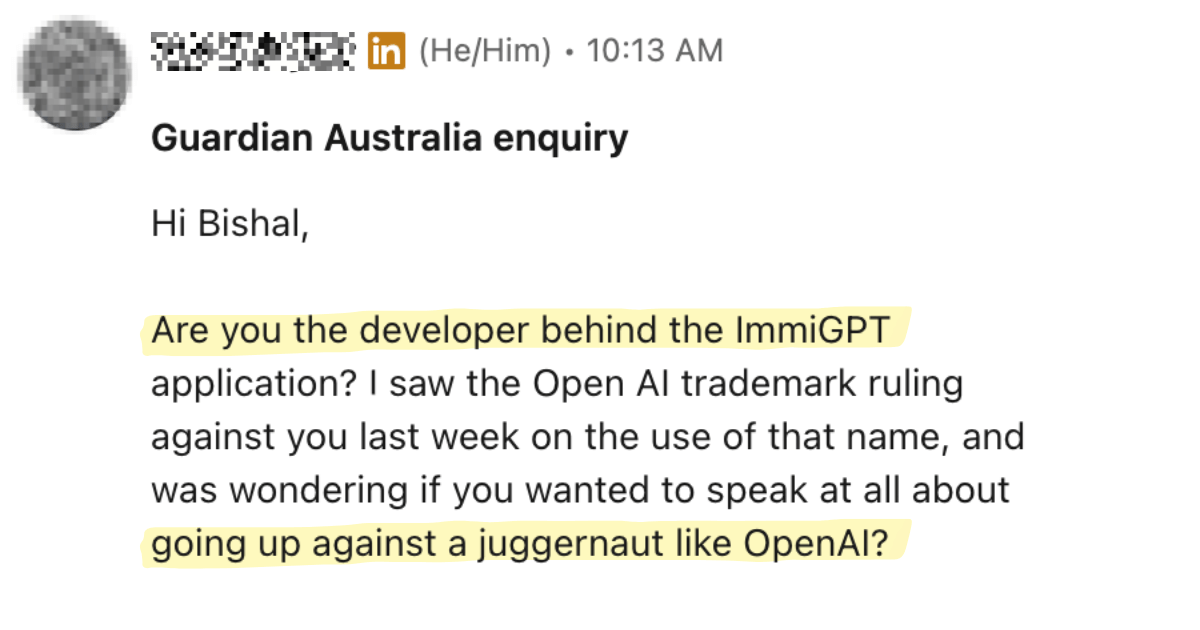
Sometime late last year, a tech reporter from The Guardian slid into my LinkedIn DMs.
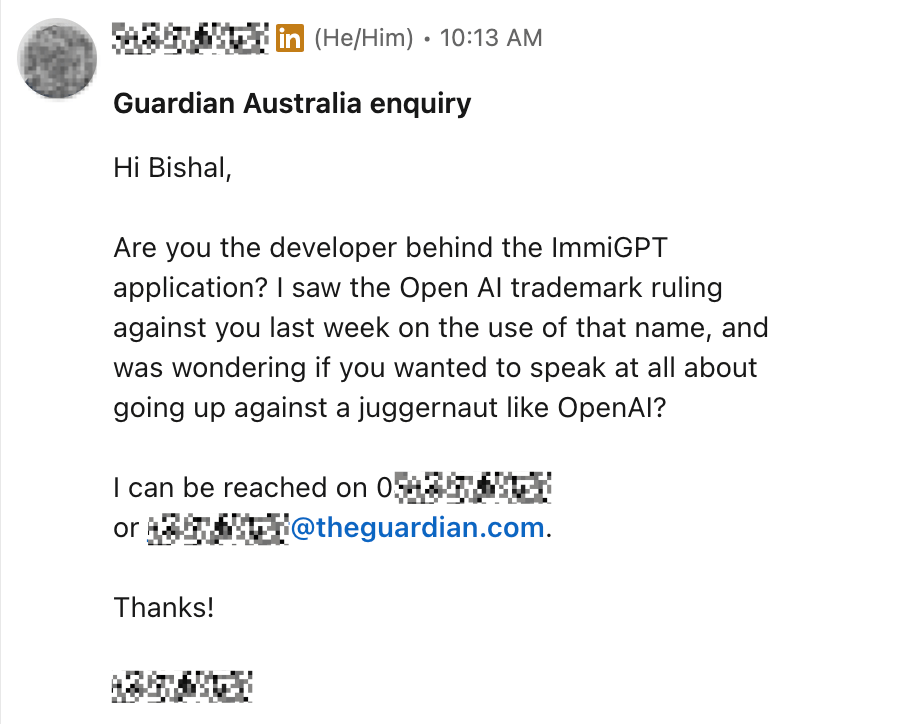
Hi Bishal, are you the developer behind the ImmiGPT application? I saw the OpenAI trade mark ruling against you last week and was wondering if you wanted to speak at all about going up against a juggernaut like OpenAI?
For about three seconds, I genuinely considered what my opening line in The Guardian would be.
Then I read it again. I had built a weekend PoC called ImmiGPT about 2 years ago. Was there a lawsuit against me I was not aware of?
It wasn’t me. False positive. But the story behind that DM is worth telling, because it’s a much more interesting story than “OpenAI sues small dev.”
A weekend project, three years ago
Back in 2023, well before “RAG” had a beefy Wikipedia page that anyone had read, I shipped a little proof of concept I called ImmiGPT. The idea was straightforward: take the Australian immigration system, possibly the most painfully bureaucratic body of content I’ve ever read, and wrap a chatbot around it that actually gave you accurate, up-to-date answers.
Under the hood it was pretty simple by today’s standards: embeddings over a curated dataset of immigration policy and visa subclasses, retrieval at query time, and an LLM generating the response grounded in the retrieved chunks. Classic retrieval-augmented generation. The win wasn’t novelty, it was that the chatbot didn’t hallucinate visa subclass numbers the way a vanilla LLM would.
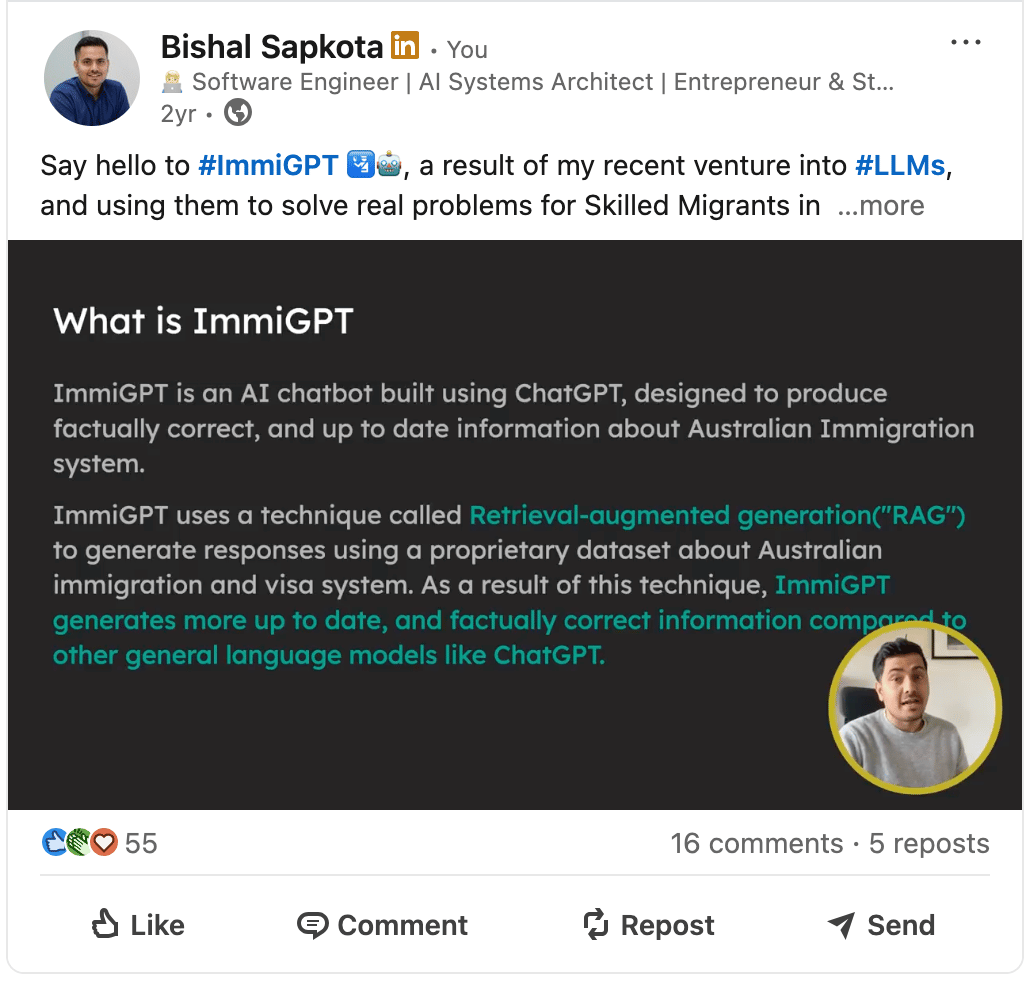
I posted about it on LinkedIn, got some lovely engagement from the migrant tech community, and then mostly moved on. It was a PoC. Just one of those projects you ship to learn.
The actual case (the one that wasn’t mine)
What I didn’t know, until The Guardian DM, was that an Australian company called RealOZ International Pty Ltd had, somewhere along the way, filed to register IMMIGPT as an Australian trade mark in class 45 (immigration advisory services). Their product was a chatbot too. Powered by Dify, with a polite disclaimer on the site that they were “not affiliated, associated, authorised, endorsed by, or in any way officially connected with OpenAI.”
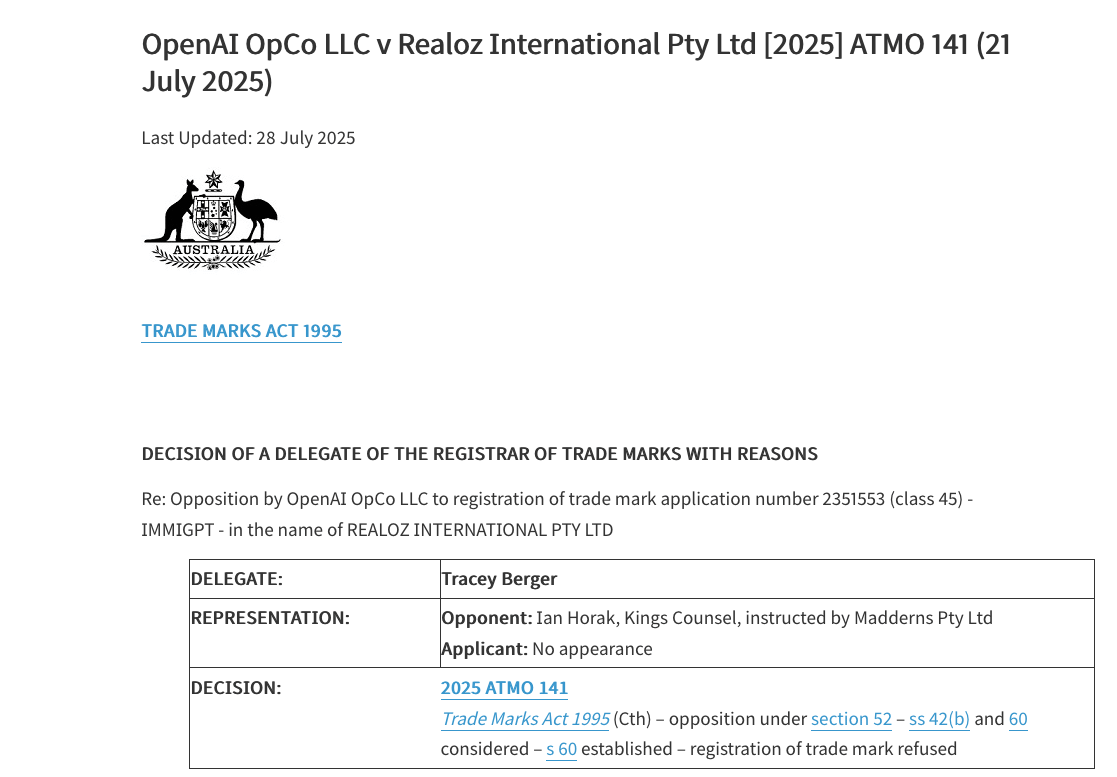
OpenAI opposed the application.
On 21 July 2025, the Delegate of the Australian Registrar of Trade Marks ruled in OpenAI’s favour. The case, OpenAI OpCo LLC v Realoz International Pty Ltd [2025] ATMO 141, refused registration of IMMIGPT.
That’s the ruling the Guardian reporter saw. And because there was exactly one other public artefact on the internet that paired the words “ImmiGPT” and “developer”, it landed in my inbox.
The interesting details of the case
OpenAI does not own “GPT” as a registered trademark. This is the part most LinkedIn takes get wrong. The USPTO has already rejected OpenAI’s application to register GPT, on the grounds that it’s generic, it stands for Generative Pre-trained Transformer, a technical term that long predates ChatGPT in academic literature. Generic terms don’t get trademark protection.
So how did OpenAI win in Australia? Through reputation.
Australian trade mark law (specifically s 60 of the Trade Marks Act 1995) lets you oppose someone else’s registration if your unregistered mark has acquired enough reputation in Australia that the public would likely be deceived or confused by the new mark. OpenAI argued that ChatGPT and GPT had built such overwhelming reputation in Australia by the time RealOZ filed that the average consumer seeing “ImmiGPT” would assume some kind of connection to OpenAI.
The “not affiliated” disclaimer on RealOZ’s site? Delegate was unpersuaded. By that point, the reasoning goes, the brand association was strong enough that disclaimers couldn’t undo it.
Why this matters if you’re shipping AI products
If you’re naming an AI tool right now, here’s what the case actually tells you:
The trademark you’re trying to clear isn’t just “GPT” the word. It’s the reputation of GPT in the minds of consumers in your jurisdiction. That’s a moving target, and it has been moving fast in one direction since November 2022. Reportedly OpenAI has opposed more than 60 GPT-flavoured marks globally, they are actively defending this reputation in IP offices around the world.
And yet I still see new “[Something]GPT” products launch every other week. Most of them will probably never face an opposition because the founders aren’t filing trade marks, or because nobody notices. But if your AI product gets any traction, the “-GPT” suffix is a slow-burn liability. Pick the name as if the product works.
The other lesson is more about who actually owns words. GPT is, definitionally, a generic technical term. It came out of papers. Anyone can build a generative pre-trained transformer. But “owning a word” in trade mark law isn’t about the dictionary definition, it’s about whose name comes to mind when consumers hear it. OpenAI doesn’t own GPT the acronym. They own (most of) the meaning people now attach to it. That’s a strange kind of ownership, and watching it crystallise in real time has been interesting story in AI space.
On building things that outlive their context
The weirdest part of all this isn’t the trade mark law. It’s that a 2023 weekend project, something I shipped, posted about once, and largely forgot, was still searchable enough in late 2025 that a Guardian reporter wrote to me about it.
I think there’s a small lesson in that for anyone who builds. The things you ship don’t disappear. They sit in the search index, in someone’s bookmarks, in the LinkedIn algorithm’s memory. Sometimes they come back useful, a former colleague reaching out years later because of something you wrote. Sometimes they come back as a case of mistaken identity for a trade mark dispute you weren’t a party to.
Either way: ship the thing. You don’t really get to choose which projects end up with a long tail.
If you want to read the original decision: OpenAI OpCo LLC v Realoz International Pty Ltd [2025] ATMO 141 is up on AustLII.